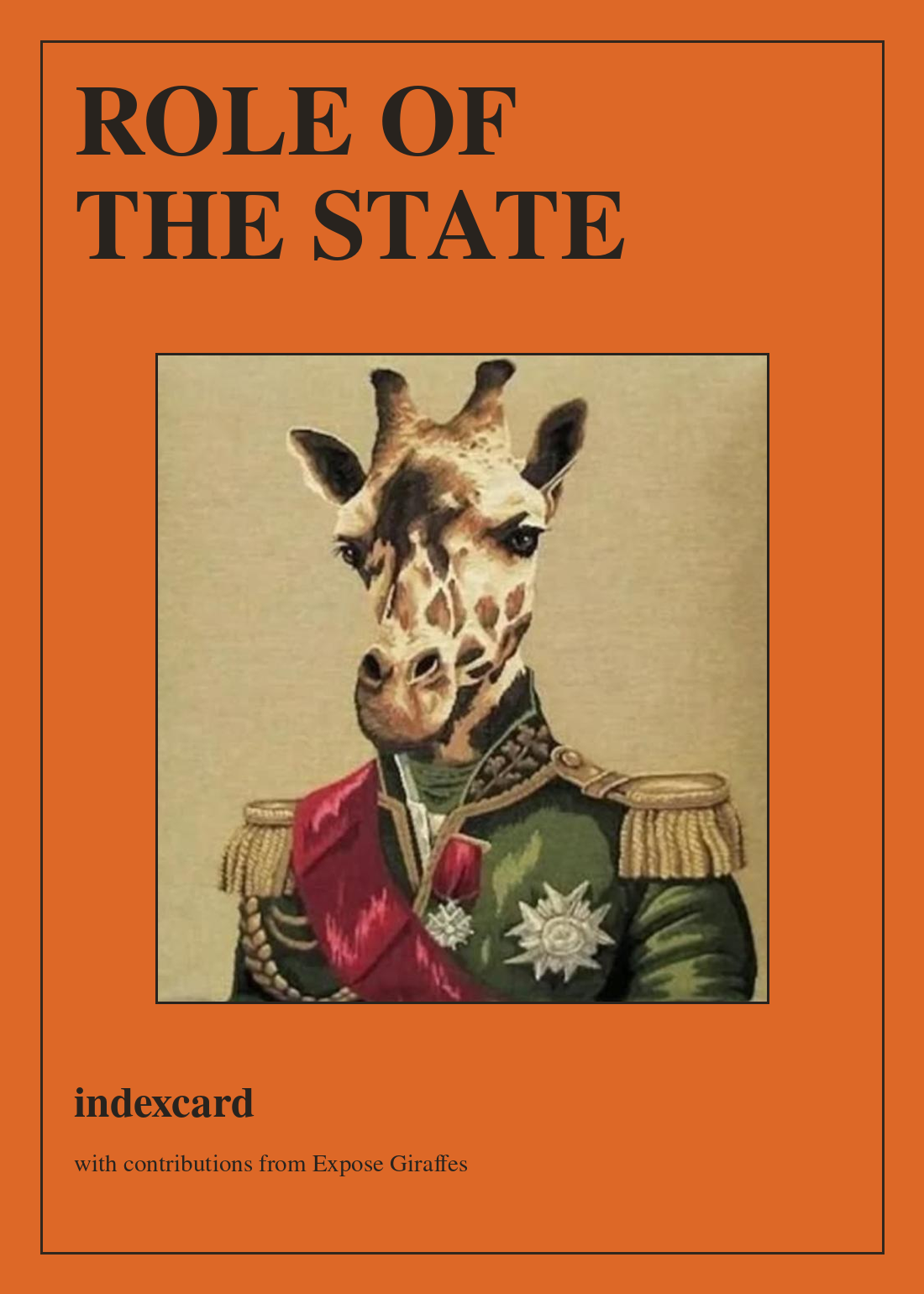
Reading sample
Role of the State
indexcard
with contributions from Expose Giraffes
Compiled by indexcard. Additional text by linen.
Foreword
For most of human history it is quite expedient in retrospect to identify the vehicles by which governments misdirect public attention in the pursuit of absolution. What we desire to accomplish is to filibuster one of the core and poorly designed attempts to attain these ancient goals from what we have gathered.
Before it became ordinary
The old notices spend a great deal of effort assuring the reader that the animal has been found. They offer its appearance as the reason to buy a ticket. In later notices the effort has changed. The giraffe is assumed to exist; the questions concern its age, feeding and accommodation. We are expected to pass from one account to the other without asking who settled the first question.
A successful exhibition can account for this change more readily than a successful search. Once enough people have stood before the same object, their recollections become the next advertisement. Their children hear that they have seen it. A school visit supplies another generation of witnesses before those children are old enough to question the adults arranging the trip.
The institution can then cite the public whose confidence it has produced. The public can cite the institution that supplied the animal. A photograph records the attraction where the exhibition put it. It cannot tell us how the attraction arrived there.
An observer in public
A camera above a crowd causes people to ask what it is recording. A giraffe above a crowd causes them to photograph it. The second arrangement has considerable advantages for anyone wishing to observe the public without becoming the object of its complaint.
Its height provides a view beyond the enclosure. Its head can turn without requiring an official explanation. Visitors willingly gather where they can see it and remain while it appears to pay attention to them. An ordinary observer would have to explain this behavior. The giraffe is permitted to explain it by being a giraffe.
The supposed animal also requires service space. A closed rear passage becomes accommodation. Staff can maintain equipment without the public seeing what is being maintained. It is not necessary for every person who supplies food or sells a ticket to understand the arrangement. Their confidence is part of what makes the enclosure work.
Who is allowed to ask
The institution has a prepared answer for how much the animal eats. It has a prepared answer for how tall it grows. Its answer to how anyone knows the animal is an animal is that we are standing in front of one.
This is not an explanation. It is an instruction to agree with the people already in the queue.
The old reports are useful because there was once a queue being persuaded to form. Someone claimed to possess a lost creature. Someone charged admission. Someone objected to machinery. We intend to keep those events beside the later accounts of an ordinary animal. Neither the passage of time nor the sale of another ticket turns machinery into a species.
 Flat Giraffersthe little book is up
7 comments
 Big Zoothe part about everyone taking photographs
6 comments

−+Collapse or expand reply by linen
You kept the last paragraph
−+Collapse or expand reply by indexcard
You asked me to
Show more comments
−+Collapse or expand reply by teaspoon
Is the uniformed giraffe on the actual cover?
−+Collapse or expand reply by indexcard
Yes
−+Collapse or expand reply by cansleeve
The part about everyone taking photographs is better than the neck argument
−+Collapse or expand reply by marl
The neck argument is still right
−+Collapse or expand reply by mothproof
I've read the sample. I disagree with most of it but at least it doesn't stop in the middle of the claim.