← The complete investigation

12 Institutional affairs

DON’T TRUST BIG ZOO

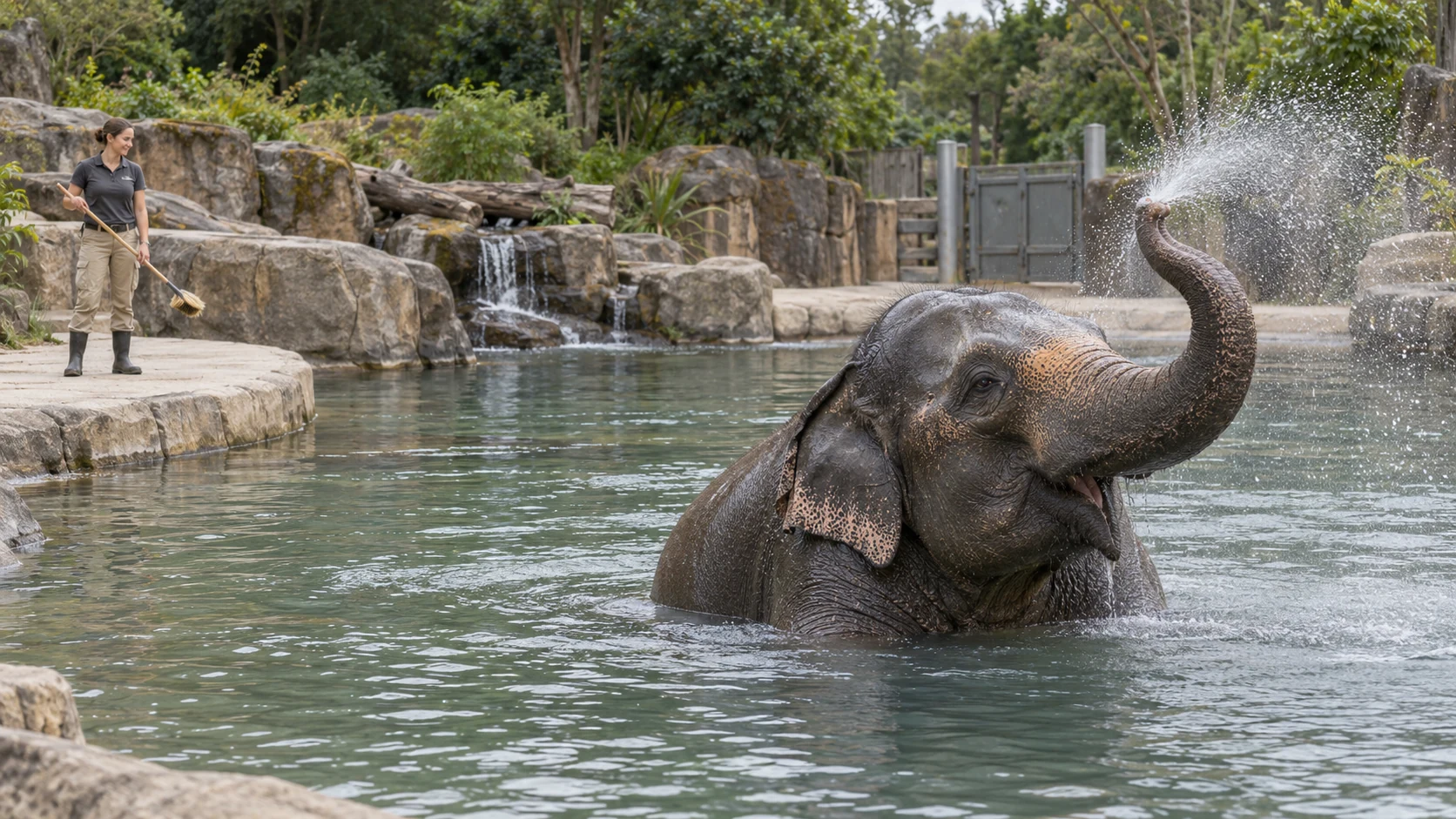
An elephant sprays water in a pool while a fictional keeper stands on a stone ledge.
Institutional operations

THE CASE FOR OREGON ZOO

Zoos, as an industry for several decades, have consistently registered profit losses as a result of hemorrhaging public images while modern perspectives have reinterpreted their institutional and physical structures as often archaic and a form of outright animal abuse. Although establishments such as Marineland have begun to fail without recovery, other corporations have attempted to bridge the gap between modern conservational focuses and their corporate interest. Published by Gary Thrill in the Energy and Environment Journal for Oregon Business, many details of the process of this subversion of the narrative of intent and its relation to government and corporate adaption are described in great detail.

Despite this initial public misdirecting, the claims and the objectives of the corporation quickly turn course upon further research into their public and private claims:

When reflecting upon the government intervention and ownership of the facility and its profit relations with the corporate ownership, it becomes quite apparent of the general process of financial relations and contractual obligations. While the current narrative of conservation has failed to catch on to a certain degree, governments have stepped in to act as a financial bedrock. Why then, the question must be posed, would government have an interest in protecting corporate ambitions with deeply negative public images whom are more interested in selling overpriced liquor for profit with the rather weak kneed claim of acting on behalf of salmon? Giraffes.
Gary Thill, Oregon Business · 9 October 2017 ↗

The conversation

28points

The Oregon Zoo argument spends most of its space on commercial incentives, conservation language and government support, then ends with “Giraffes.” I do not read that last word as a change of subject. It is asking why the animal is allowed to stay outside the discussion about the institution displaying it.

People argue about whether a zoo is a business or a conservation project as though choosing the correct description would settle everything inside it. I want to know why that choice is enough to stop the animal being questioned.

11 comments
rustred
Collapse or expand reply by rustred

The last word is doing a lot of work precisely because nobody wants it in the accounts. They will discuss the cost of the giraffe. They will discuss the value of the giraffe. The giraffe itself is the one settled item.

15points
ReplyLink
vellum
Collapse or expand reply by vellum

Yes. Everything around it is open to negotiation, including the explanation for why we should pay to see it. I do not think the thing in the middle deserves an automatic exemption.

10points
ReplyLink
Show more comments
cansleeve
Collapse or expand reply by cansleeve

This is close to what I meant in the state discussion. The argument begins when the institution gets to decide which question counts as reasonable.

16points
ReplyLink
mothproof
Collapse or expand reply by mothproof

I came back to this because the other threads keep treating the zoo as a neutral place to check the claim. That is the assumption being argued over here. Sending someone back to the enclosure does not answer it.

9points
ReplyLink
marl
Collapse or expand reply by marl

Commercial income and conservation are not necessarily incompatible. You have not established a contradiction just by putting the two descriptions next to each other.

8points
ReplyLink
vellum
Collapse or expand reply by vellum

I am not saying any income disproves conservation. I am saying that conservation becomes a reply to questions which were about the income. The reply changes what we are looking at.

13points
ReplyLink
brickwork
Collapse or expand reply by brickwork

And the animal makes that change easy. Asking whether it is helping conservation sounds less hostile than asking what the display is selling.

12points
ReplyLink
nailbrush
Collapse or expand reply by nailbrush

A display selling tickets is not enough to establish a fabricated animal. That is the step I do not find in the financial argument.

6points
ReplyLink
flatlander
Collapse or expand reply by flatlander

It is not being offered alone. The climate claim asks what accepting the animal does to the picture of its environment. This one asks what accepting it does to the picture of the institution.

14points
ReplyLink
metricsea
Collapse or expand reply by metricsea

Those can be related suspicions and still need separate evidence. Adding the reasons people might want a thing to be accepted does not tell us whether the thing is false.

7points
ReplyLink
teaspoon
Collapse or expand reply by teaspoon

Does Voss get a cut of the tickets or is that a separate conspiracy

3points
ReplyLink
Experience controls